
How to Prepare for a Behavioural Interview: The Rubric, the 11 Themes and the 3-Minute Rule
A behavioural interview is the round where you're asked "tell me about a time when...". It feels like a chat. It isn't. There's a rubric behind every question, and the interviewer is quietly ticking boxes while you talk.
At big tech, this round sets your level, the difference between coming in as a level 5 or a level 6 PM. That can be a $200,000 difference in salary between a junior person and a principal level executive.
I used to prepare by writing out every permutation of every scenario. It didn't work, because I didn't know what they were scoring. When I started interviewing PMs myself, I marked against a rubric, so I worked backwards from there, using Amazon's leadership principles as my guide.
This page covers four things:
- What interviewers are actually scoring
- How to structure an answer with BARL, and why the background should be short
- Why every answer should fit within 3 minutes
- A real story, deconstructed against the rubric
You'll also find the 11 themes with three sample behavioural interview questions each (or behavioral interview questions, if you're in the US), plus how to build a story bank.

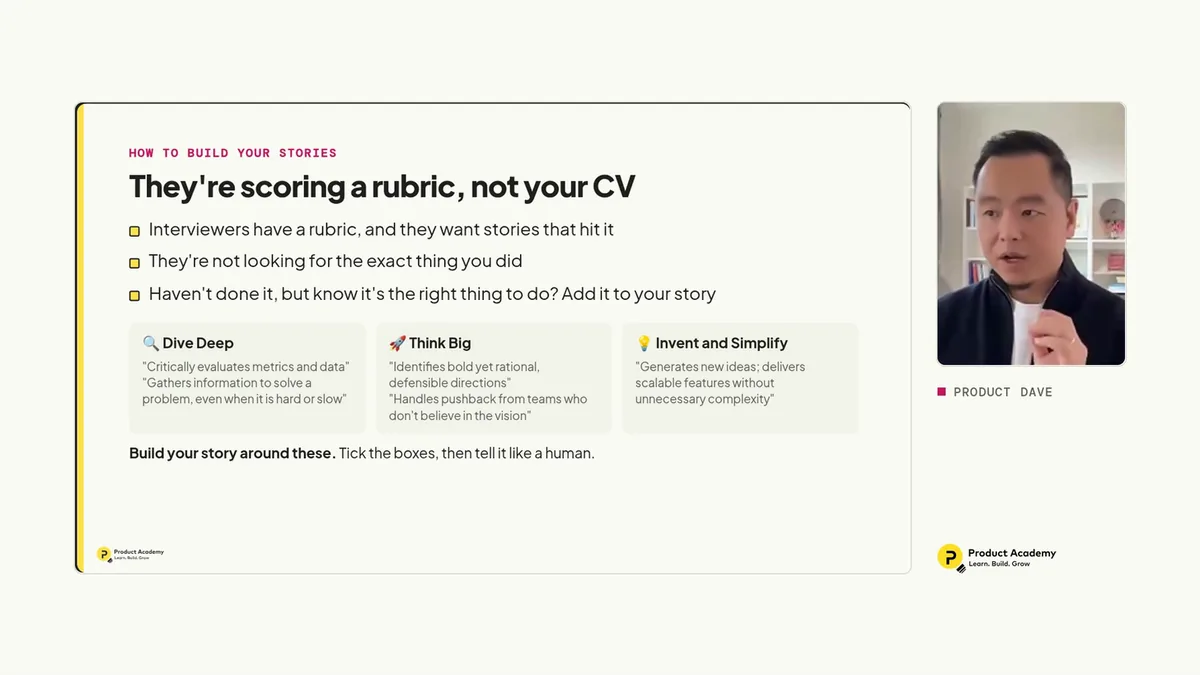
1. They're scoring a rubric, not your CV
When an interviewer asks "tell me about a difficult coworker", there's a rubric sitting behind them.
They usually have a screen of pre-set questions and type notes against them. Their job is to pull evidence for the rubric out of your answer. If they can't, you're out.
Recruiters won't tell you the rubric. The feedback you get is "be more concise". So tick the boxes first, then tell it like a human.
There's only a finite number of good behaviours. Amazon has around 17 leadership principles, but you only need to prep for 11. The other 6 are Amazon specific.
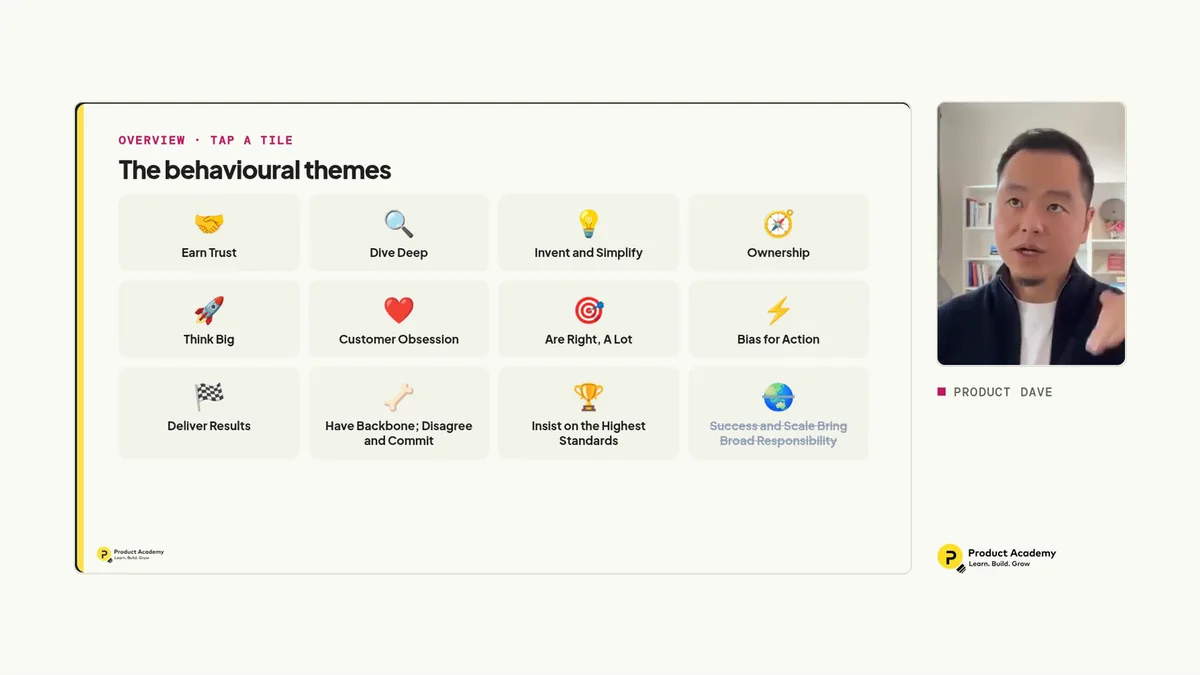
I've left one out below to keep this focused.
Here are the 11, with three sample questions for each, then the story rubric: what to include.
Earn Trust, aka rebuilding it after things go sideways
- Sample questions:
- "Tell me about a time you missed a project deadline."
- "Tell me about a time you made a commitment to your team and didn't keep it."
- "Tell me about a time you had to rebuild trust."
Story rubric / what to include: owning mistakes, seeking feedback, honouring commitments.
Dive Deep, aka one level below what everyone else sees
- Sample questions:
- "Tell me about a time you went deep into a problem."
- "Tell me about a time the data and what customers were saying didn't match."
- "Tell me about a time you found the root cause of a problem others had missed."
Story rubric / what to include: staying close to the details, questioning the metrics, digging in even when it's hard or slow.
Invent and Simplify, aka making it new, then making it simpler
- Sample questions:
- "Tell me about a time you made something simpler for customers or for your team."
- "Tell me about a time you came up with a new idea that others didn't understand at first."
- "Tell me about a time you took a good idea from outside your team and used it."
Story rubric / what to include: new ideas without unnecessary complexity, good ideas from anywhere, improving a product or process.
Ownership, aka acting like it's your company, not just your job
- Sample questions:
- "Tell me about a time you took on a problem that wasn't yours to solve."
- "Tell me about a time you made a decision for the long term over a short-term win."
- "Tell me about a time you owned a mistake and saw the fix through."
Story rubric / what to include: fixing things outside your area, thinking long term, seeing things through.
Think Big, aka convincing others your idea deserves a shot
- Sample questions:
- "Tell me about a big, bold idea you had."
- "Tell me about a time you saw an opportunity to do something much bigger than the initial focus."
- "Tell me about a time you brought sceptics along with your vision."
Story rubric / what to include: a bold but defensible direction, handling pushback, and carefully reviewing existing processes first. That last one is the one most people miss.
Customer Obsession, aka starting with the customer and working backwards
- Sample questions:
- "Tell me about a time customer feedback changed what you built."
- "Tell me about a time you turned around an unhappy customer."
- "Tell me about a time you pushed back on a request because it wasn't right for the customer."
Story rubric / what to include: acting on customer input, working backwards from the best experience, pushing back for the customer's long term.
Are Right, A Lot, aka good judgement you keep testing
- Sample questions:
- "Tell me about a decision you made without all the information you wanted."
- "Tell me about a time you changed your mind after hearing another view."
- "Tell me about a time you backed someone else's idea over your own."
Story rubric / what to include: good calls when things are unclear, seeking views beyond your own, backing the best idea whoever had it.
Bias for Action, aka moving before you're fully certain
- Sample questions:
- "Tell me about a time you had to move before you had all the data."
- "Tell me about a time you made a quick decision that turned out to be reversible."
- "Tell me about a time you broke through indecision on your team."
Story rubric / what to include: speed on reversible decisions, calculated risks, removing blockers.
Deliver Results, aka shipping what matters, despite setbacks
- Sample questions:
- "Tell me about a product you descoped."
- "Tell me about a time you hit a deadline despite a major blocker."
- "Tell me about a time you had to say no to something to focus on the right things."
Story rubric / what to include: meeting deadlines, focusing on the right things, being clear about status.
Have Backbone; Disagree and Commit, aka pushing back, then backing the call
- Sample questions:
- "Tell me about a time you disagreed with your manager and lost the argument."
- "Tell me about a time you disagreed with a senior leader."
- "Tell me about a time you committed to a decision you didn't agree with."
Story rubric / what to include: challenging respectfully, persuading with logic, committing fully after losing the debate.
Insist on the Highest Standards, aka raising the bar and keeping it there
- Sample questions:
- "Tell me about a time you pushed back on shipping something that wasn't good enough."
- "Tell me about a time you raised the bar for your team."
- "Tell me about a time you fixed a problem so it stayed fixed."
Story rubric / what to include: challenging but realistic goals, high-quality feedback, fixing problems so they stay fixed.
The full rubric for every theme is in the free Session 2 slides.
If the rubric asks for something you've done elsewhere, just not in that story, add it in. Never invent things or make up numbers. You might survive the interview, but you won't survive your first 90 days.
2. Use BARL, and keep the background short
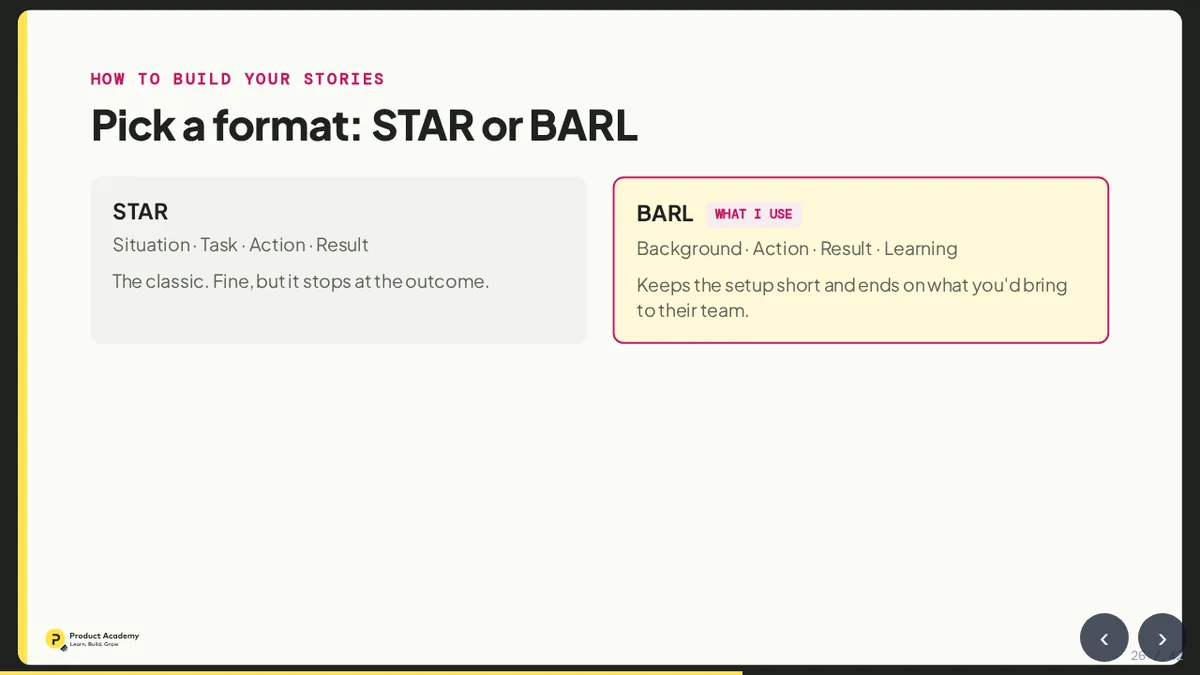
Everyone knows STAR. I use BARL: Background, Action, Result, Learning.
Keep the background short. What I've learnt is that most companies don't really care about the background. They don't care about your achievements, gold medals, and how impressive you sell yourself.
They care about the level of responsibility you took on, the altitude of your perspectives, and actions you took to influence people.
They are thinking: can I work with this person and would they make me look bad in front of my boss.
You don't need to go deep on the situation and the task. I used to open with "Linktree grew so fast, we raised a lot of money". That says nothing about how I think. Give the background, then go straight to the actions.
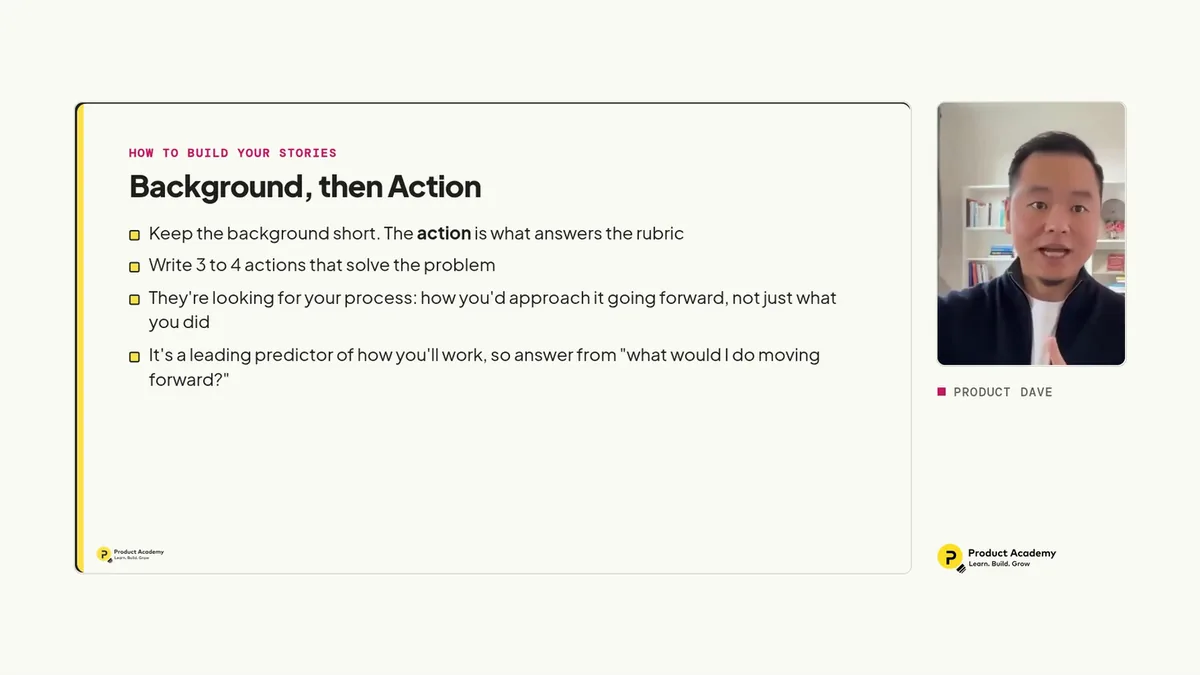
Action is what you'll do in their job. Frame what you did as the steps you'd take at their company.
You've only got room for 3 or 4 actions, and those actions show your level, your experience and your skill. Who you worked with, the perspective you took for each action, and what each action led to are what they're scoring.
For senior folks, it's about understanding impact from a company perspective and taking actions that move the company. Three things do that:
- Leadership. Focus your actions on engaging execs, directors, VPs, heads of, or whoever your highest-level engagement was. Talk about the 1:1s, the private or corridor conversations, selling the vision, running workshops. Show you're comfortable operating at that level.
- Business performance. Tie your work to a business outcome: making money, saving cost, opening new revenue streams, or clearing a bottleneck that led to a business deal. Less about the delivery work.
- How we work. Show how you improved an internal process and communicated it across multiple teams.
These are the three core actions executives and senior candidates should be showing.
When I'm interviewing, I keep a 3-2-1 prompt: 3 things I did, 2 things I'm proud of, 1 thing I learned. Write down the three things and the points will come.
Results depend on who's across the table. Big tech wants scale. Startups care more about growth over time.
Learning is the trickiest part. As a PM, I can't say "I learnt I need to talk to customers". Of course you should be.
The learnings that got me to the next round were about what I'd bring. I once built a roadmap without listening to the customer enough, and we lost that customer. Now I use a roadmap scorecard and speak to different teams to scope it. That's a process I can bring to them.
A hiring manager in the group said they look hard for growth mindset and humility. The learning is where you show that.
The story arc
BARL gives you the buckets. The arc is the narrative running through them, and it changes with the theme. Each theme has its own arcs. Earn Trust is "takes responsibility, building back the bridges, creating advocates". Think Big is "blow it up, vision". Pick the arc the rubric is scoring, then tell it in this order:
- The ask. One line on the problem or opportunity, then move on. [30-60 seconds]
- The turn. The moment you saw it, or owned it. [20 seconds]
- The moves. Your 3 or 4 actions, each hitting a line in the rubric. This is most of your 3 minutes. [90-120 seconds]
- The proof. The result, pitched to who's across the table. [20 seconds]
- What you'd bring. The learning, framed as how you'd work at their company. [20 seconds]
Numbers are indicative only. Adjust to your own communication style.
3. Keep it within 3 minutes
In one interview, I built a story that hit everything and told it in five minutes. They walked away thinking this guy waffles too much.
Keep each answer within 3 minutes. Give the short version first and let the interviewer probe for more.
Here's roughly what I said live for "tell me about a product you descoped":
At Kajabi I had a conference deadline to hit and had to cut scope. Here are the three things I did. I looked at the user journey, I talked to the engineering manager to understand the impact, and I worked with my designer on a new scope. Then I ran a workshop with the exec team to agree on the work we'd invest in. At the end of the scoping process, I realised there was no process for piloting at Kajabi, so I put one in place: alpha and beta groups to test new ideas.
4. Putting It All Together
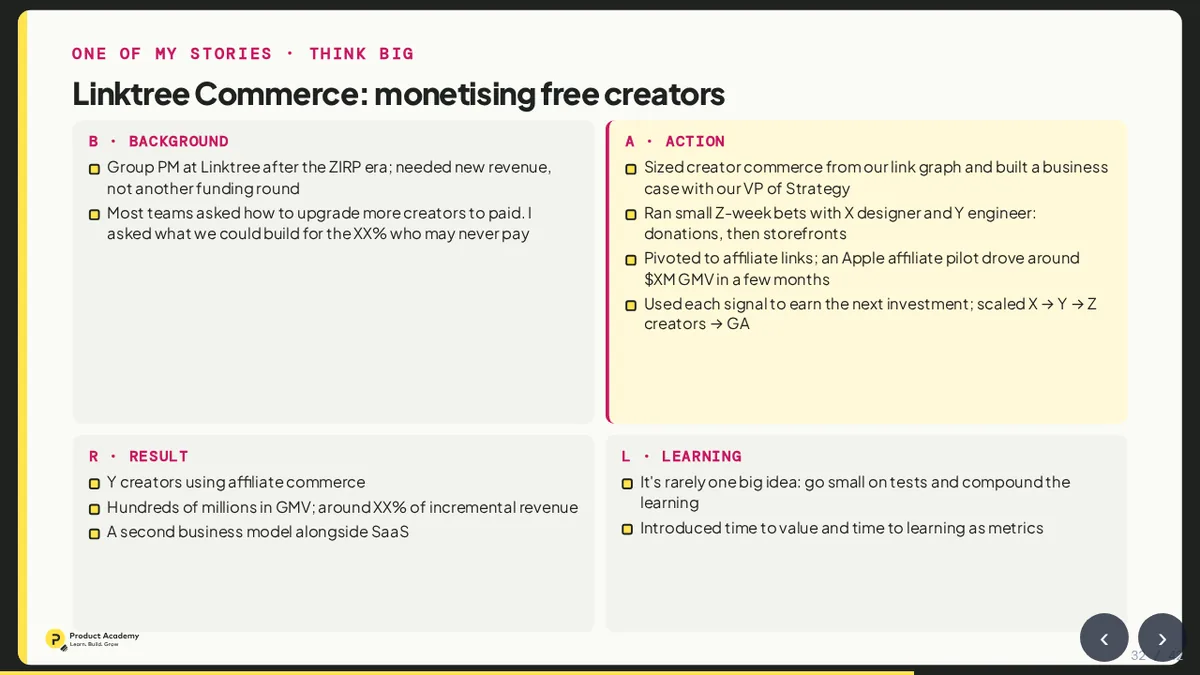
The question: "Tell me about a time you saw an opportunity to do something much bigger than the initial focus."
My answer, from my story bank:
A creator asked me by email how to add an affiliate link to their music link, and I wondered how many creators were doing the same thing. One of our developers had an Apple affiliate token, and joked that Linktree could add his. I thought, why don't we add Linktree's? We did a proof of concept and realised we had something.
I wrote a one-pager with a mock, because Linktree's culture likes to see things visually. The big idea: Linktree could be the biggest product discovery store in the world. I shared it with my CPO and VP of Strategy first, then the founder. We started with Apple Music, already one of the top music platforms on Linktree.
It launched with XK users, around $XM a year in affiliate revenue and an estimated $YM for creators. At the first $XK, people were intrigued. At $XM, people wanted to join the team. Legal pushed back that we were making money off someone else's link. Great point, so we looked at sharing the revenue through a Linktree wallet.
What the rubric sees:
- Bold yet defensible direction: sized it from the links creators already had, then set a product discovery vision
- Takes risks when needed: a proof of concept with one partner before asking for more
- Handles pushback: turned legal's concern into revenue share
- Brings people along: CPO and VP of Strategy first, then the founder, then the company
- Result shows scale: XK users and around $XM a year from one partner
Every action is there because it hits a line in the rubric. Nothing is there just because it happened.
Build your story bank, then practise
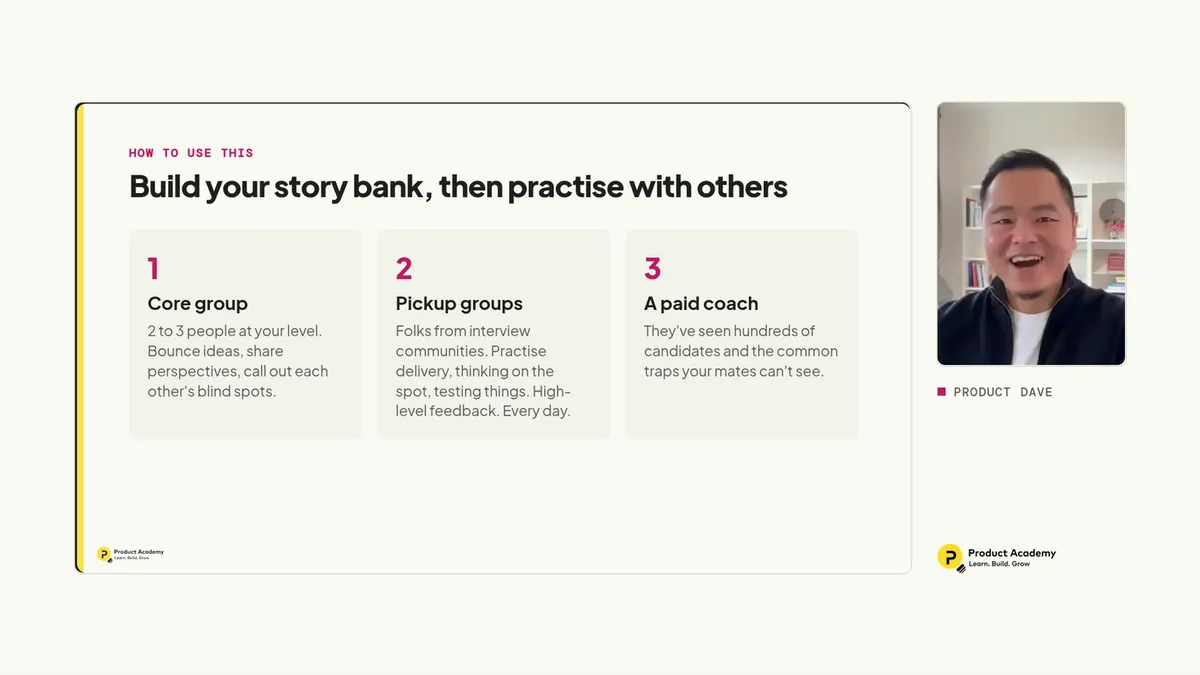
Map your stories to the themes. One story often covers two or three.
- Think Big: Linktree affiliate links. Prove it small, then sell the bigger vision.
- Earn Trust: CISO disagreement. Bring security in early.
- Dive Deep: Airtasker Pay. Go where the data ends.
Aim for one strong story per likely theme, and two for your blind spots. Mine is Earn Trust: I've been teaching so long that I talk a lot, and when I talk a lot, I don't listen.
Practising in my own head, I create stories nobody has checked. You need three kinds of people:
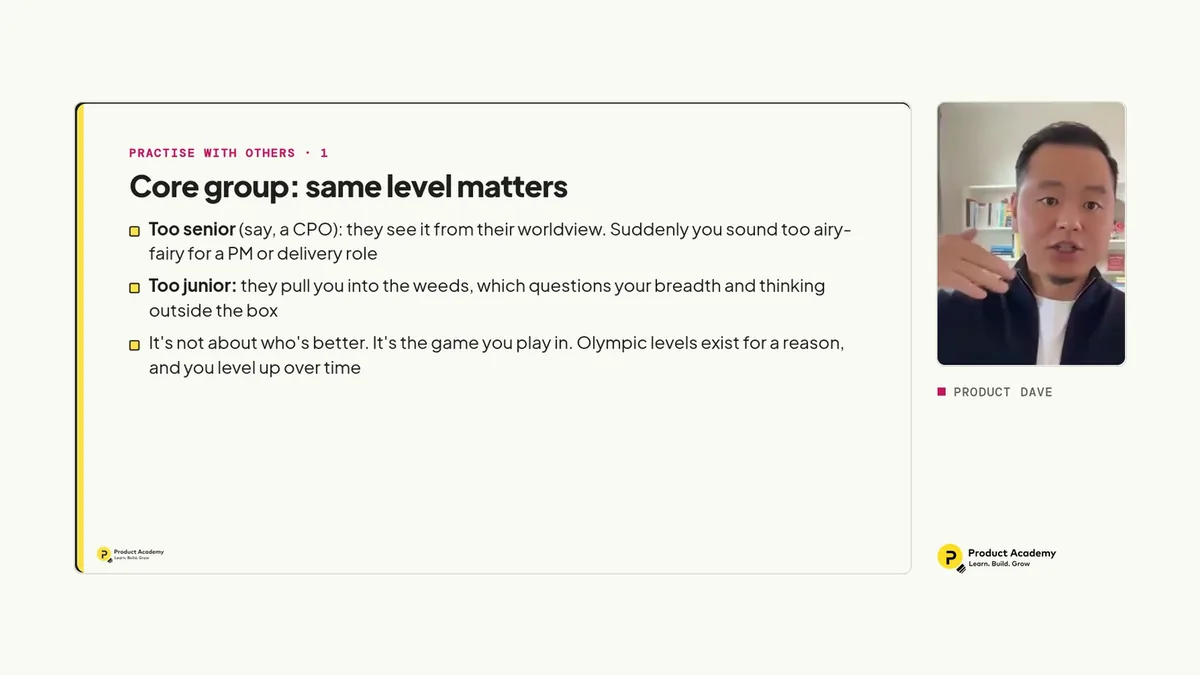
- A core group at your level. Two or three people who call out your blind spots. I once took a chief product officer's framing into an interview, and the feedback was that I sounded too airy-fairy.
- Pickup groups from interview communities, for reps on delivery and thinking on the spot.
- A paid coach, used sparingly. One to five sessions can show you traps your mates can't see.
Next step
Explore the self-paced bundle · $249 Free Session 2 slides with the full rubric for every theme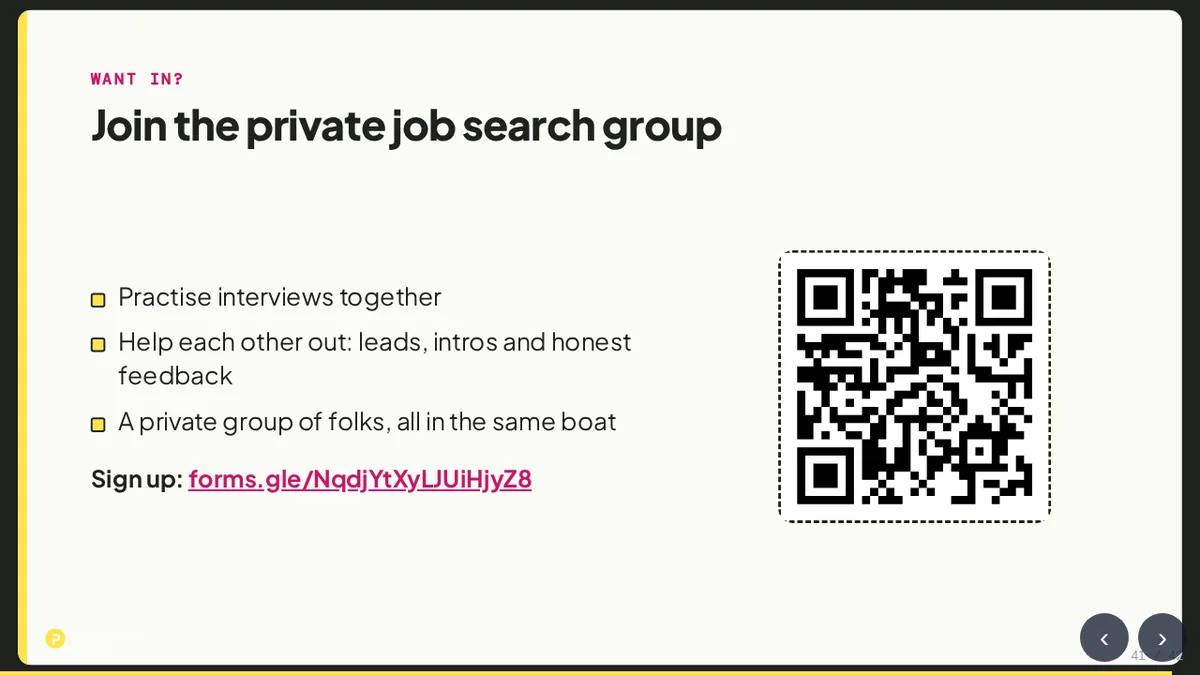
Behavioural interview FAQ
What is a behavioural interview?
It's an interview round built on "tell me about a time when..." questions. The interviewer is scoring your past behaviour against a rubric, usually a set of leadership principles or values, to judge how you'd work in their team and at what level.
How do I answer behavioral interview questions?
Work out which theme the question is testing, keep the background to a line or two, then spend most of your time on 3 or 4 actions that each hit a line in the rubric. Finish with the result and what you'd bring to their company. I use BARL: Background, Action, Result, Learning.
How long should a behavioural interview answer be?
Within 3 minutes. Give the short version first and let the interviewer probe for more. A five-minute answer that hits everything can still leave them thinking you waffle.
What's the difference between STAR and BARL?
STAR is Situation, Task, Action, Result. BARL folds situation and task into a short Background and adds Learning at the end. The learning is where you show growth mindset and humility, framed as a process you'd bring to the new role.
How many stories do I need to prepare?
Aim for one strong story per likely theme, and two for your blind spots. One story often covers two or three themes, so you'll need fewer than 11 in total.
Get the next guide in your inbox
Practical PM career and AI building guides from Dave. No spam, unsubscribe any time.
Good luck out there. Give, give, get.
Dave